Google Advertising
Google Ads Match Types for Service Businesses
People still explain google ads match types the way they were explained in 2016. Exact meant exact. Phrase meant the words in order. Broad meant chaos. That model is out of date, and it’s a big reason local accounts either over-restrict until the account starves or go full broad with no bidding system that can keep up with the junk.
Google’s current Help pages describe three matching options: broad, phrase and exact. Here is what they mean now, how they overlap, and how a service business can choose between them without inventing a “new in 2026” feature Google never documented.
Google ads match types in plain words
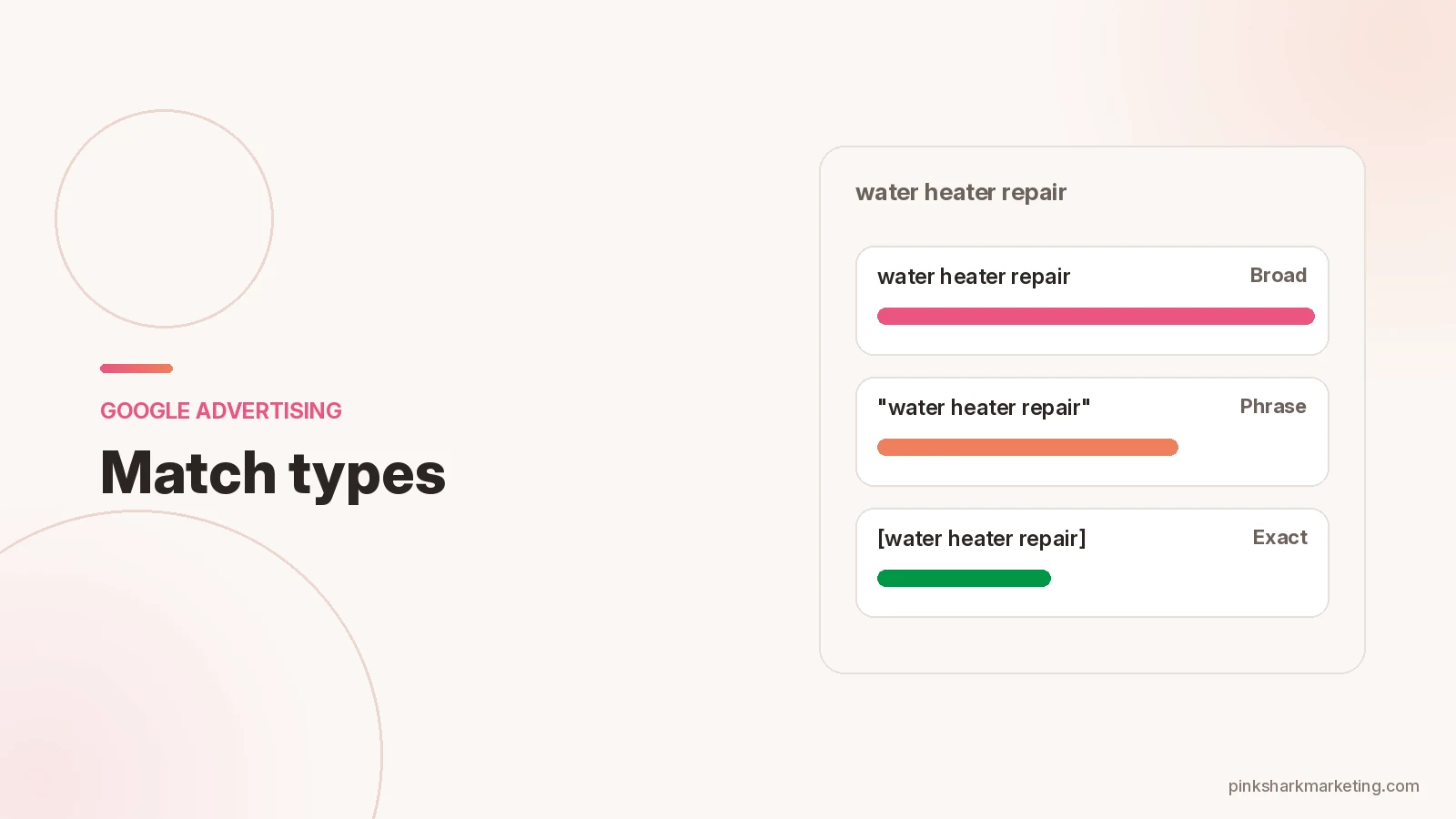
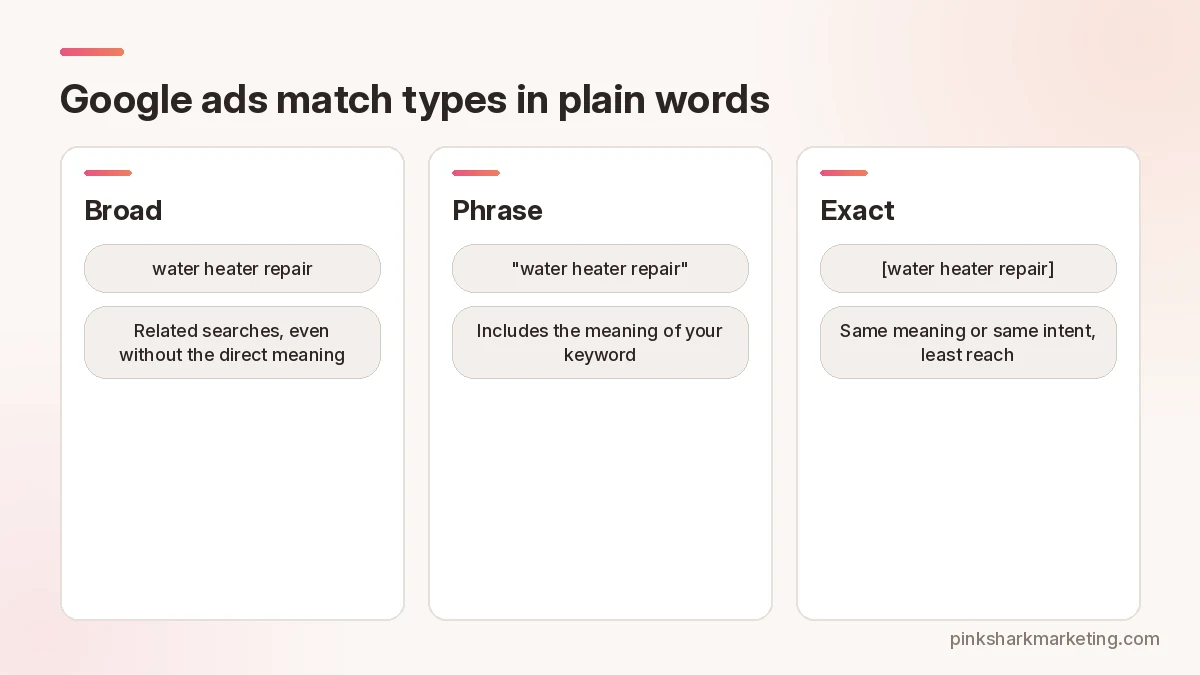
You tell Google which one you want with symbols, and the symbols are simple. Plain text is broad. Quotes make it phrase, like “water heater repair”. Brackets make it exact, like [water heater repair]. That’s the syntax in Google’s Add keywords Help. What each one actually does is less obvious.
Broad match (no special symbols) may show ads on searches related to your keyword, including searches that don’t contain the direct meaning of the keyword. Google says it’s the default match type. Help also lists extra signals broad match may use: the user’s recent search activity, landing page and asset content, and other keywords in the ad group.
Phrase match may show on searches that include the meaning of your keyword. Google says phrase reaches more than exact and less than broad, and that the meaning can be implied or more specific.
Exact match may show on searches with the same meaning or same intent as the keyword. Google describes it as the option with the most steering and the least reach of the three.
Stacking one keyword three ways
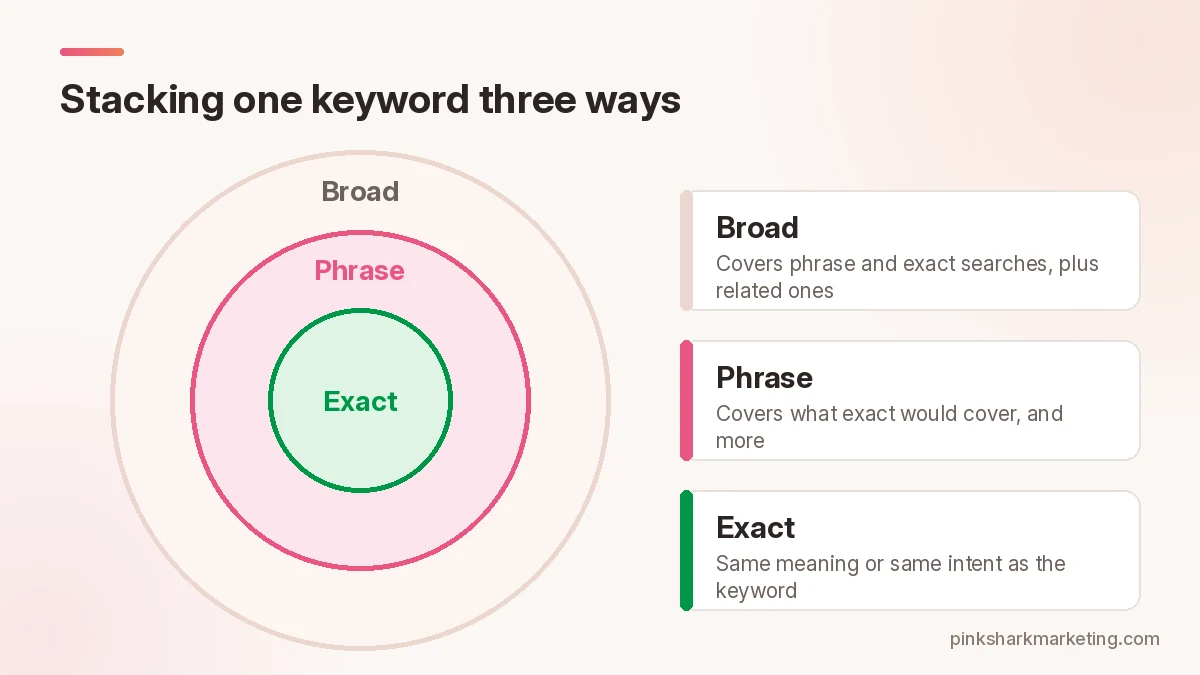
A fair question: if the three types differ, why not run the same keyword as all of them? Because Google is blunt about the overlap. Broader match types capture the queries of narrower ones, plus more. Phrase covers what exact would cover, and more. Broad covers everything phrase and exact would, plus additional related searches.
Stacking often adds clutter and no control. Google notes that very similar broad keywords can be treated as duplicates, and the higher Ad Rank version is the one used. You still get one bid in the auction, even if your spreadsheet holds twelve near-copies.
For tighter steering, put exact or phrase on the money terms. If you want coverage, use broad on a clean theme with the right bidding and negatives. Repeating the same string three ways is usually busywork dressed up as strategy.
Broad match needs Smart Bidding
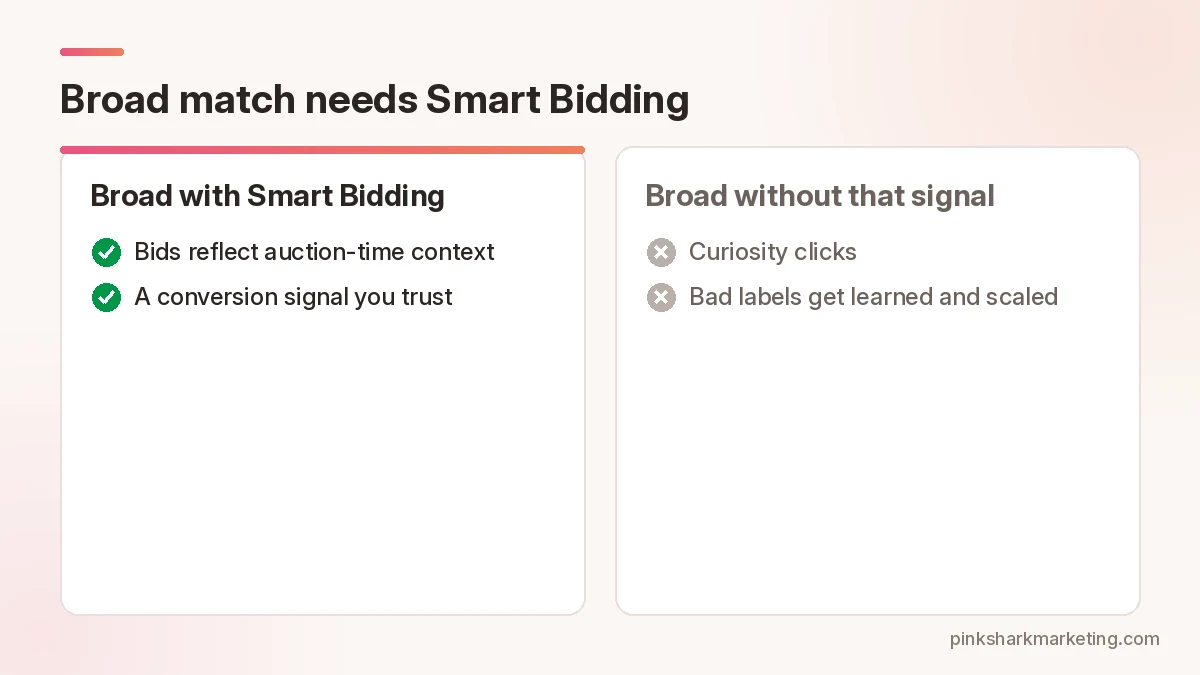
Broad match with no conversion signal you trust is a gamble.
Google’s match-type Help says it’s critical to use Smart Bidding with broad match, because each query is different and bids should reflect auction-time context. The broad match guide makes the same point: Smart Bidding uses signals so you compete in the right auctions, at the right bid, for the right user, instead of for every related search on earth.
That’s guidance, not a guarantee of cheaper leads. Without a signal you trust, broad is a fast way to buy curiosity clicks from people who wanted a YouTube tutorial. With broken call tracking it’s worse, because the bidding system learns from bad labels and then scales them.
If conversions are thin or late, tighten match types and search themes until the measurement is honest, then widen carefully. Skip that order and “we tried broad” turns into a ghost story.
Want a second set of eyes on your search terms?
Our Google Ads team will review where your clicks are going.
What actually changed
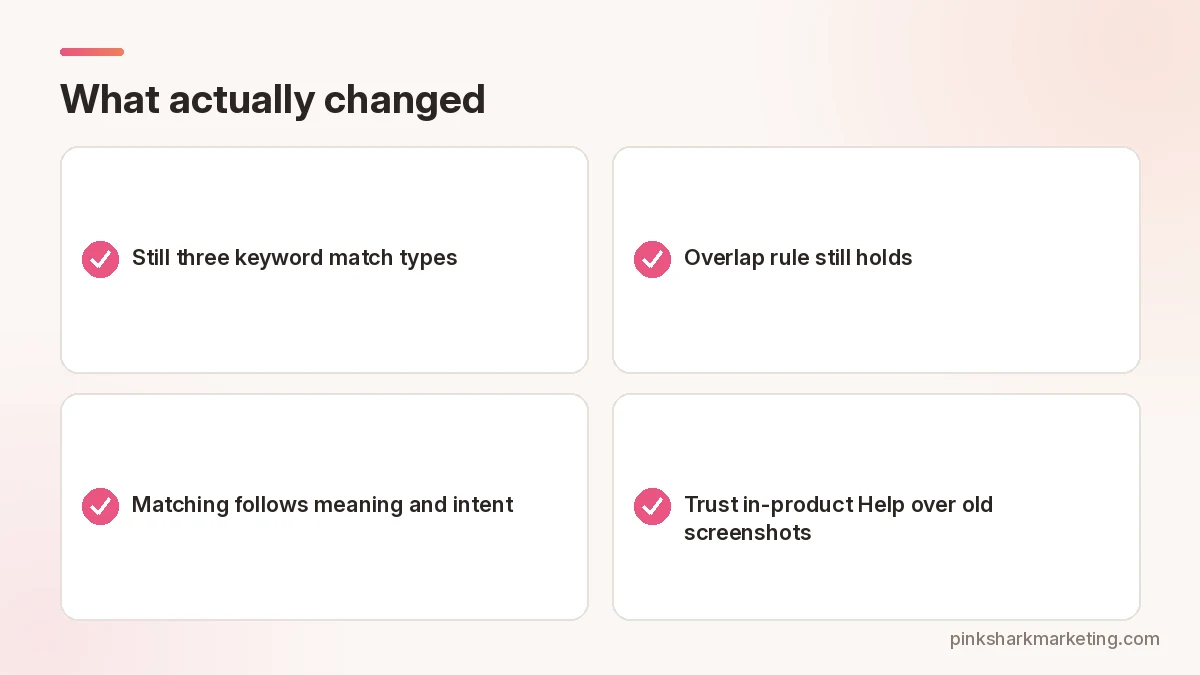
Over the last several years, Google has moved keyword matching toward meaning and intent, not only literal strings. Exact match already includes close variants with the same meaning. Phrase is meaning-based too. Broad reaches related searches beyond direct meaning.
What didn’t change, going by the Help pages checked on 2026-11-06, is that there are still three options and the overlap rule above still holds. Nothing there asks you to claim a brand-new match type invented for this calendar year. If a UI label, recommendation or automation name in your account differs from an older blog post you bookmarked, trust the in-product Help and the current support articles over a screenshot from 2021.
AI Max, Performance Max search themes and recommendation cards can appear beside classic keywords, depending on the campaign type, and availability and labels vary. This article sticks to the three documented keyword match types on Search keywords. Google keeps a separate Help section on Performance Max versus Search prioritization, so re-check it on the day you change an account instead of treating any blog as frozen policy.
How we’d set this up for a local service brand
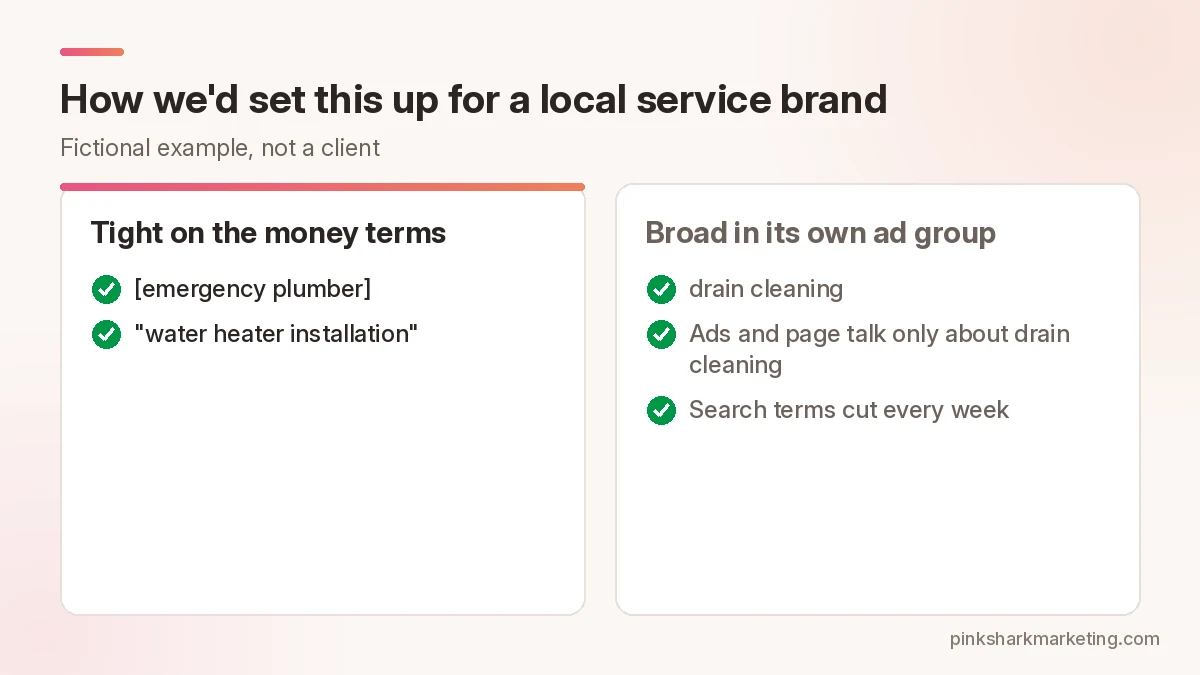
Fictional example, not a client: a plumber keeps [emergency plumber] and “water heater installation” tight, then adds broad drain cleaning in an ad group whose ads and landing page talk only about drain cleaning. Junk queries get cut from the search terms report every week. That’s a system. A single ad group with fifty overlapping match-type clones of the same phrases isn’t.
Start with the jobs you actually sell. Put exact or phrase on the high-intent service + geo ideas you can’t afford to misunderstand. Use broad on a small set of core themes, and only after negatives for DIY, jobs, parts and out-of-area terms are in place.
Then read the search terms report after any change. The match type on the keyword and the match type on the search-term row are related but not identical, which Google explains in the search terms Help. Cleanup still happens there.
Mistakes that waste a month
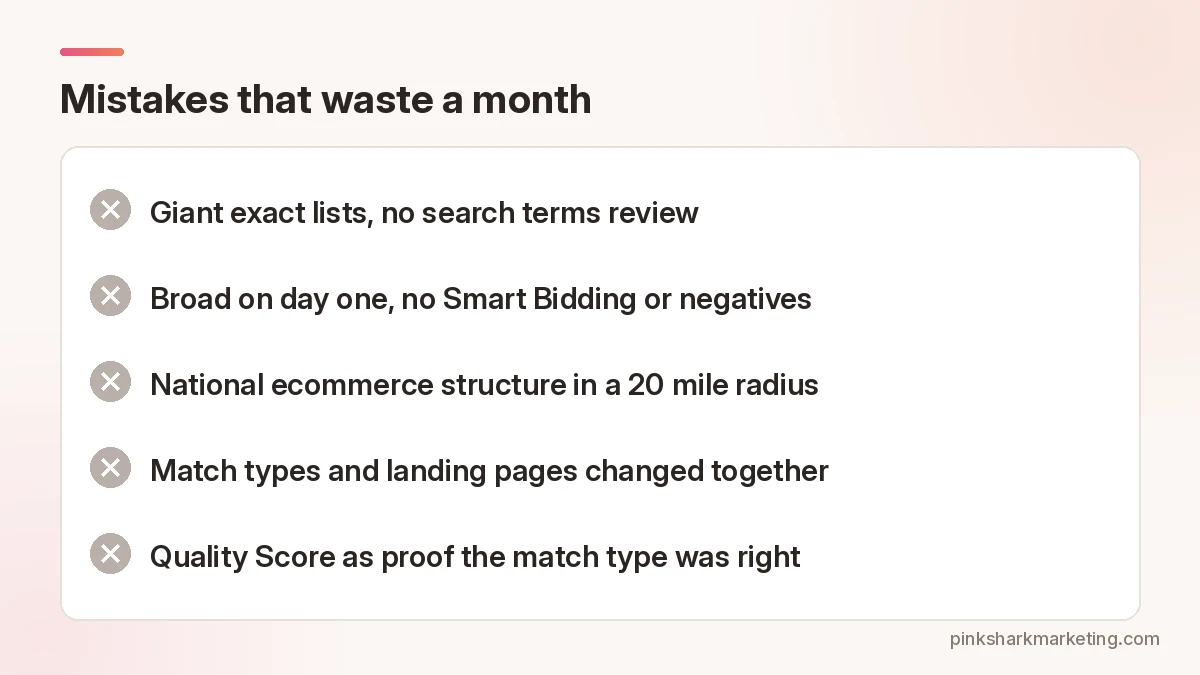
- Building giant exact lists and never looking at search terms
- Going broad on every keyword on day one with no Smart Bidding and no negatives
- Copying a national ecommerce structure into a twenty-mile service radius
- Changing match types and landing pages in the same afternoon, then guessing which change mattered
- Treating Quality Score or impression volume as proof that the match type choice was right
Jobs booked are the scoreboard.
For hands-on help, see Pink Shark’s Google Ads management service or contact us. If the click is fine and the page is the leak, start with landing pages and CRO.
If your cost per lead keeps creeping up, let’s look at the account together.
Related reading
- Google Ads Help, About keyword matching options
- Google Ads Help, Your guide to broad match
- Google Ads Help, About the search terms report
FAQ
What are the Google Ads match types right now?
Google documents three keyword matching options for Search keywords: broad match, phrase match and exact match. Broad is the default, phrase uses quotes, exact uses brackets. Broader types include the reach of narrower types plus more.
Is exact match still literally exact?
Not in the old character-for-character sense. Google says exact match may show on searches with the same meaning or same intent, including close variants. For the fine print on a specific query pattern, check the current Help examples.
Should a local plumber use only broad match?
Only with care. Google recommends Smart Bidding with broad match and clean signals. Many service accounts still keep exact or phrase on the highest-intent jobs and use broad on a few core themes, behind strong negatives and honest conversion tracking.
Do I need the same keyword on broad, phrase and exact?
Usually not. Google notes broader match types already cover narrower query sets, and duplicate near-identical keywords add maintenance without a second auction bid. A clear structure and a weekly search terms cleanup work better.
Did Google add a brand-new match type in 2026?
The Google Ads Help pages checked on November 6, 2026 still describe broad, phrase and exact as the three keyword match types. Menu labels and the names of automations differ between accounts and get renamed over time, so before you decide a new match type exists, check what Google’s current documentation says.
Want a second set of eyes on your marketing?
Tell us about your business and we’ll set up a strategy session.